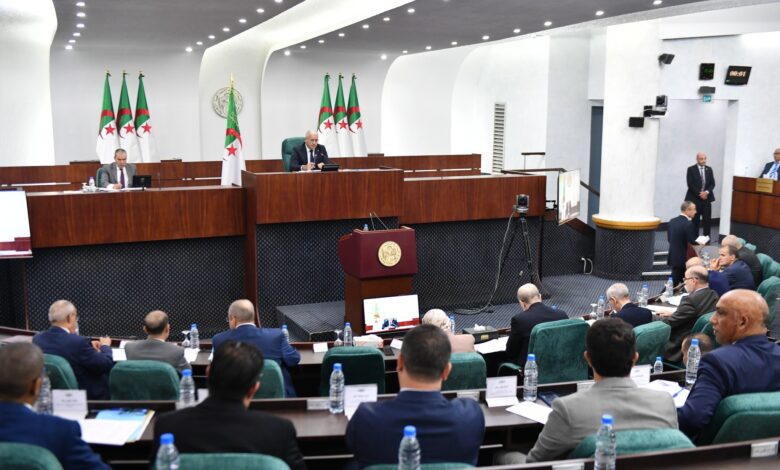
The Office of the National People’s Assembly has scheduled Tuesday, November 18, to hold a voting session on Draft Finance Law for the year 2026According to the schedule of work of the National People’s Assembly during the period from 09 to 20 November 2025, “elhiwar us“A copy of it will be voted on on Tuesday.
Of the 84 amendments submitted by the representatives to the Council’s office, 12 amendments were referred to the committee after fulfilling the legal conditions, and a significant number of them were approved, while the committee proposed amending Article 89, which proposes a tax settlement for economic operators and large merchants who evade paying taxes. The amendment that the committee came up with stipulates reducing the single tax rate released from 10 to 8 percent within the framework of the exceptional procedure for voluntary tax settlement directed at natural and legal persons who wish. To settle their status with the tax administration before December 31, 2026.
This step falls within the existing efforts to expand the tax capacity base that would provide revenues for the state’s public treasury, which was confirmed by Finance Minister Abdelkarim Bouzard, in his response to the representatives’ interventions during the discussion of the draft finance law for the year 2026. He said that Article “89” of the draft finance law for 2026 related to the voluntary tax settlement is radically different from that approved in 2016, and he said that “The current article does not aim at all to attract merchants’ money outside the banks, but rather gives an opportunity to merchants and businessmen who are not disciplined in their tax declarations to settle their legal status in exchange for paying 10 percent of what they declare, which is a step that encourages them to return to the legal path and expands the state’s tax base.
Among the amendments that the committee studied and rejected was the amendment to Article 159 bis 3, which amends the provisions of Article 65 of the Finance Law of 2003, which deals with the phenomenon of invoicing or non-submission, which has become widespread due to the lack of parallelism in fines with the living reality. Therefore, the representatives proposed amending this article as follows: “Without prejudice to the penalties, a fine of 200,000 thousand Algerian dinars shall be imposed for retailers and two million dinars for For wholesalers and four million Algerian dinars for producersImporters2,000,000.00 DZD, two million for wholesalers, and 4,000,000.00 DZD, four million Algerian dinars for producers and importers.”
The representatives came up with another amendment and it was the subject of a wide and extensive discussion within the Finance and Budget Committee. According to sources who attended the meeting, the proposal was accepted in principle. The matter relates to the proposal to exclude weak municipalities from the system of deducting 50 percent of the fee while abolishing the fee on professional activity for the year 2023. According to the reasons stated, some municipalities know of a significant weakness in their incomes, similar to the municipalities located in these four states, which makes them unable to cover their basic expenses and ensure the reduction. The minimum level of public services for citizens. Therefore, implementing the system of deducting 50 percent of the fee and canceling the fee on professional activity for the year 2023 will inevitably lead to a significant decline in the incomes of these municipalities, even though they had previously relied on these materials by almost 100 percent to manage their local affairs. From this standpoint, this proposed amendment came with the aim of including special exceptions for the benefit of municipalities with weak incomes by proposing to exclude them from this deduction from Low-income municipalities are determined by the organization in order to preserve their financial balance and enable them to continue performing their development and service tasks towards citizens.
Among other amendments, copies of economic real estate belonging to the state’s private property within small activity areas are assigned to a state committee headed by the regionally competent governor. This is in order to add transparency and equal opportunities in the granting process and to protect the authority of the governor. The category of craftsmen is also included in the category that can benefit due to the real estate needs that this category suffers from in order to develop their profession.
Fouad Q
#Voting #session #Finance #Law #Tuesday #Algeria
oussama_boulegheb