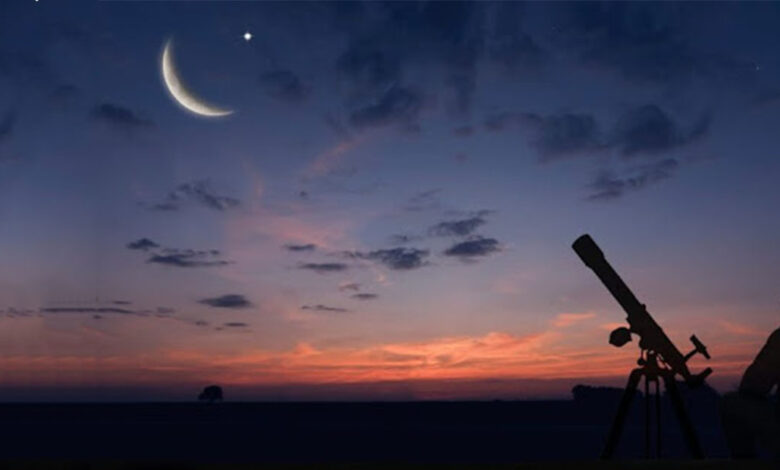
The International Astronomy Center warned of the danger of confusing the moon and the crescent during the inspection of the crescent of the month of Ramadan, stressing that seeing the crescent on Tuesday will be scientifically impossible, due to the moon’s extreme proximity to the sun at sunset, which makes any attempt to observe with a telescope or binoculars a danger to the safety of observers.
Solar eclipse on sighting of the Ramadan crescent
The International Astronomy Center explained, in statement He posted on his official page on Facebook that the solar eclipse will affect the sighting of the Ramadan crescent in 2026. Engineer Muhammad Shawkat Odeh, Director of the International Astronomy Center, explained that professional astronomical observatories avoid directing telescopes towards the moon on the day of investigation, because its proximity to the sun may lead to direct sunlight entering the lenses, which may cause damage to the devices or severe damage to the eyes that may lead to loss of vision.
According to astronomical data, the angular distance between the sun and the moon will be very limited, which will place the sun within the field of view when trying to observe the crescent moon, which is a known danger in astronomical observation.
Why is it impossible to see the crescent moon?
The center’s experts explained that the impossibility of seeing the crescent moon is due to several factors: the moon setting before or with the sun in large areas of the Islamic world. The moon remains for a very short period after sunset, not long enough for the visible crescent to form. The angular elongation between the Moon and the Sun has decreased to limits that prevent visual viewing even using advanced telescopes.
The occurrence of a solar eclipse on the day of investigation is evidence that the moon is still in the new phase, which is the phase that precedes the observable crescent.
The moon is not the crescent
The center pointed out that confusion between the two terms sometimes causes confusion among the public, as some believe that the appearance of the moon means the beginning of the Hijri month, while the legal and scientific basis relies on the visible crescent only.
What happens astronomically on the day of investigation:
In the Islamic East: the moon sets before the sun.
In the central regions: The moon sets almost with the sun.
In West Africa: The moon sets a few minutes after the sun, which is not long enough for the crescent to form visually.
The Moon’s proximity to the Sun also makes any observation attempt risky, especially for amateurs who use equipment not equipped for conditions near the Sun.
The impact of this on the beginning of Ramadan
Although the official decision to determine the first day of Ramadan rests with the religious authorities in each country, astronomical calculations indicate that countries that rely on visual vision will complete the month of Shaban with thirty days, with the first day of Ramadan being the next day.
The difference in the beginnings of the Hijri months between countries is due to the difference in legal standards, between those who require actual sighting and those who rely on astronomical calculations with the possibility of sighting.
A call to stay away from random monitoring
The center stressed the need for amateurs not to make ill-considered observation attempts on Tuesday, especially using binoculars or telescopes without solar filters, to avoid direct dangers to eyesight.
He also called for the accreditation of official observatories and specialized bodies when announcing the results of the crescent moon sighting, and avoiding misleading testimonials or images spread on social media.
Between science and legal vision
Crescent detection combines scientific accuracy and Sharia jurisprudence, as astronomical calculations provide an accurate perception of the possibility of sighting, while religious institutions rely on their Sharia rules to announce the beginnings of the months.
Specialists confirm that scientific development reduces errors and confusion, especially when astronomers clarify the circumstances that make the vision scientifically impossible, as is the case this year.
When does Ramadan start astronomically?
The Center expects that Thursday, February 19, will be the first day of the month of Ramadan in most Arab and Islamic countries that adopt legal sighting, anticipating the possibility of seeing the crescent with the naked eye on Wednesday evening in areas such as Mecca, Abu Dhabi, Amman, Cairo, and Rabat, where the moon’s age will be between 25 and 29 hours, with a suitable elongation angle that allows for safe monitoring.
#Monitoring #Ramadan #crescent. #International #Astronomy #Center #warns #Algeria