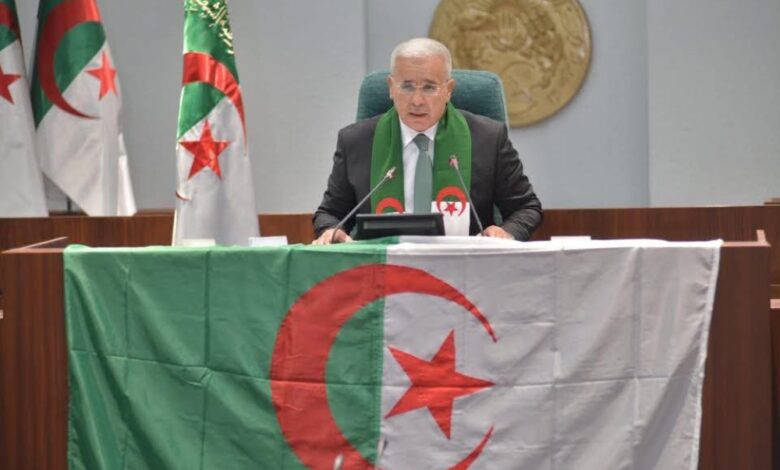
On Saturday, the President of the National People’s Assembly, Ibrahim Boughali, presented before the Assembly’s representatives a proposed law related to criminalizing the French colonization of Algeria, stressing that this session is a sovereign act par excellence, a clear moral position, and a clear political message that expresses Algeria’s adherence to its inalienable right to defend its national memory and preserve the dignity of its people.
Boughali stressed that this proposal must be remembered as a moment of awareness and loyalty, and a turning point in the path of modern Algeria, in which the state, through its legislative institution, renews its covenant with national memory and with the conscience of history.
Criminalizing colonialism…a people’s issue that transcends differences
The President of the Council highlighted that the issue of criminalizing French colonialism is not an issue of a group or a political trend, but rather an issue of an entire people, in which sensitivities dissolve, differences are eliminated, and positions are united around it, as it is directly linked to the sacrifices of the martyrs and the dignity of the Algerian nation.
He pointed out that the confidence that parliamentarians gave him to present this proposal reflects a collective awareness that the nation’s crucial issues require unity of ranks and integration of positions, far from any narrow calculations.
A proposed law to define responsibilities
Boughali explained that the proposed law proposal includes an accurate enumeration of French colonial crimes in Algeria, with a clear definition of the French state’s responsibility for its colonial past, in addition to establishing legal mechanisms to demand official recognition and an explicit apology, as well as the inclusion of penal measures that criminalize glorifying or promoting colonialism.
In this context, he stressed that this approach does not target a specific people, nor does it aim to seek revenge or incite hatred, but rather stems from a dedicated legal and moral principle, which states that crimes against humanity are not subject to a statute of limitations, are not justified by force, and are not closed by silence.
French colonialism…was a project of uprooting and dispossession
The President of the Council stopped at the true nature of the French colonization of Algeria, stressing that it was a fully-fledged project of uprooting and dispossession, which usurped the land and confiscated it from its legitimate people, distributed it to the settlers, and made the Algerian a stranger in his homeland, deprived of the bounties of his land, and deprived of his right to a decent life.
He added that this colonial project was not limited to plundering wealth, but rather extended to systematic policies of impoverishment, starvation, and marginalization, in an attempt to break the will of the Algerian people, erase their identity, and sever their connection to their historical and cultural roots.
Displacement, massacres, and torture… bloody pages in the national memory
Boughali pointed out that the colonial era witnessed policies of forced displacement and mass exile, during which families were displaced, villages and villages were emptied of their residents, and Algerians were thrown into harsh camps and camps, which were tools of collective control and breaking social and cultural ties.
He also recalled the massive massacres and deliberate killings that killed millions of innocent people at home and abroad, in addition to the practices of physical and psychological torture in prisons and detention centers, in flagrant violation of all humanitarian values and international conventions.
Nuclear explosions…a continuing crime that does not have a statute of limitations
The President of the Council highlighted one of the most serious crimes of colonialism and the most long-lasting in its effects, represented by the nuclear explosions carried out by France in the Algerian desert, which left massive health and environmental damage that successive generations are still suffering from, stressing that this complete crime cannot be forgotten and will not be subject to the statute of limitations.
The proposed law is a tribute to the martyrs and to preserve the dignity of the nation
Mr. Boughali considered that the proposed law criminalizing colonialism is an act of loyalty before it is a legal text, a defense of the truth before it is a political position, and a clear message at home and abroad that the Algerian national memory cannot be erased or compromised, and that building the present and anticipating the future cannot be based on denying the past or jumping on it.
A mature parliamentary role and national consensus
The President of the National People’s Assembly praised the continuous efforts made by the Assembly’s representatives, in this and previous terms, to keep this issue at the heart of the national debate, considering that these parliamentary initiatives reflect political maturity and a deep awareness of the role of the legislative institution.
A text specifying legal responsibility and containing provisions relating to recognition and apology
Bougali’s presentation stated that the proposal for this law is based on internationally recognized legal principles and may include some crimes committed against the Algerian people. Provisions have also been included regarding full recognition of legal responsibility and an official apology for it, in addition to material and moral restoration, and the adoption of penal measures that criminalize glorifying or promoting colonialism.
Algeria renews its commitment to loyalty to its history and steadfastness to its principles
At the conclusion of his presentation, Boughali stressed that Algeria, through this sovereign step, renews its adherence to international relations based on mutual respect, equality and cooperation, while categorically rejecting any attempt to obscure the facts or deny crimes, stressing that true reconciliation can only be built on recognition, apology and fairness.
The President of the Council concluded by stressing that the law criminalizing colonialism represents a commitment towards future generations that Algeria will remain faithful to its history, steadfast in its principles, defending the dignity of its people, and confident in its path towards building a strong state with its memory and sovereignty.
#Criminalizing #colonialism…a #loyalty #memory #moral #commitment #generations
#oussama_boulegheb #elhiwardz #alakhibariat.xyz #elhiwar #elhiwar-en