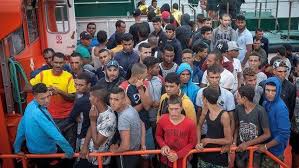
While many European countries are moving towards tightening immigration policies, Spain offers a different model based on economic benefit and social integration. The government announced a plan to regularize the status of half a million irregular immigrants, which angered the opposition.
Spain is in dire need of immigrants, who played a major role in achieving economic growth that reached 2.9 percent in 2025. Immigrants filled half of the jobs created in some sectors, including agriculture.
In a move that reflects the growing tightening in immigration policies across Europe, the leftist Spanish government announced a new plan to regularize the conditions of irregular migrants, which is expected to benefit about 500,000 people, in a measure that Madrid says will contribute to supporting the national economy and promoting social integration.
The Minister of Social Security and Immigration, Elma Saez, said that her country is experiencing a “historic day,” stressing that the government presents “a model of immigration based on human rights, integration and community cohesion.” “What we are doing is protecting people’s dignity, giving them guarantees and opportunities, and guaranteeing the rights of those who already live in our country,” Saez added.
Under the government measure approved last Tuesday (January 27, 2026), everyone who resided in Spain for a period of no less than five months before December 31, 2025 will be able to obtain legal residency and work freely in any region or sector. The Minister explained that the period for submitting applications will extend from April to June 30.
To prove residence in Spain for the required period before submitting the application for the required residence permit, a rental contract, medical reports, or money transfer receipts can be presented. Those with a criminal record are excluded from this, according to a report by the German newspaper “Frankfurter Allgemeine” on the matter.
The newspaper explained that if the application is approved, a temporary residence permit will be granted. The applicant can then work legally and benefit from public health care services. If the application is approved, a residence permit will be issued for one year, after which an application can be made for a long-term regular residence permit.
Royal decree to bypass Parliament’s obstacle
To pass this plan quickly without going through Parliament, the government of Socialist Prime Minister Pedro Sanchez resorted to a “royal decree,” which is a legislative mechanism provided by the Constitution and published directly in the Official Gazette, without the need for a parliamentary vote, in light of the government not enjoying a majority.
Madrid is moving contrary to the general European trend, as it has chosen to adopt a policy of relative openness to immigration, driven by economic reasons. Sanchez previously confirmed that 80 percent of economic growth in the past six years is due to immigrants, and said, “We are a country that strongly advocates a legal, safe, and regulated model of immigration, which must also be open and humane, in the face of those calling for closing the borders.”
The announcement of this plan to regularize the situation of irregular migrants coincided with the release of encouraging data on the labor market, as the unemployment rate fell in the last quarter of 2025 to less than 10 percent for the first time since 2008.
The Spanish labor market is in dire need of immigrants, who contributed greatly to the growth of the economy by 2.9 percent last year. Foreigners filled more than half of the jobs created in the hospitality, construction and agricultural sectors.
The Frankfurt Allgemeine newspaper noted that the immigration law was amended last year, so that applicants can now apply for permanent residence after only two years instead of three years. Immigrants must prove their integration into society, including proof of residency, a job offer from a recognized employer with a minimum of 30 hours per week, and a clean criminal record from their country of origin.
Spain, along with Italy and Greece, is one of the main entry points for migration to Europe, especially through the Canary Islands. The country recorded the arrival of 37,000 irregular immigrants in 2025, a decrease of 42.6 percent compared to 2024, according to the Ministry of Interior.
According to the National Institute of Statistics, more than seven million foreigners live in Spain out of a population of 49.4 million.
Left-wing welcome and right-wing anger
Last November, the government approved a mechanism to regularize the status of 300,000 immigrants annually for three years, in response to the aging population and the requirements of European laws. Data from the “Foncas” Research Center indicate that 91 percent of the irregular immigrants in the country, who currently number 840,000, are from Latin America, with Colombia (290,000) coming first, then Peru and Honduras, making them the group that benefits most from the new measure. Among immigrants from Latin America, there are many women who work in the field of elderly care, nursing, and child nannies.
The new government measure was welcomed by the Podemos party, the far-left partner in the ruling coalition, after its meeting with the government. But it also sparked sharp criticism from the right and the far right.
The leader of the Popular Party, the largest opposition party, Alberto Nuñez Viejo, wrote on AX:
“In socialist Spain, violating the laws is rewarded,” he said, considering that this “crazy” policy aims to divert attention from the train accident that killed 45 people on January 18.
As for the leader of the far-right Vox party, Santiago Abascal, he launched a scathing attack on Sanchez, describing him as “a tyrant who hates the Spanish people and wants to replace another people in their place.”
This reform comes in response to a popular initiative signed by more than 600,000 people and supported by about 900 associations, calling for an exceptional settlement of the conditions of all irregular migrants.
This Spanish plan is more than just an administrative measure to regularize the status of migrants, as it links migration management with improving economic performance and enhancing social cohesion. This is a step that has clear internal political repercussions, and may constitute a test of Madrid’s ability to balance its economic interests with the sensitivities of the general political scene, at a European moment characterized by great complexity in managing the immigration file. About Wd
#Contrary #European #trend.. #Spain #settles #conditions #million #immigrants
#oussama_boulegheb #elhiwardz #alakhibariat.xyz #elhiwar #elhiwar-en