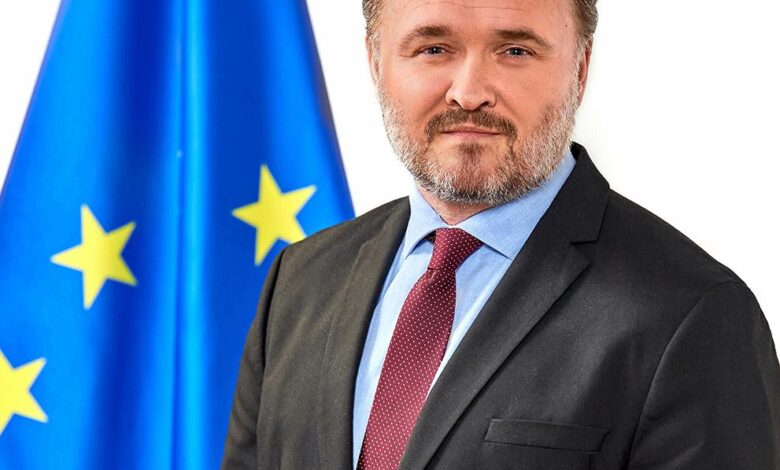
In the next few days, Algeria is expected to receive the European Commissioner for Energy Affairs, Dan Jorgensen, on a visit that falls within the European Union’s efforts to strengthen its energy partnership with Algeria, according to what was reported by the Italian news agency “Nova”, as Algeria continues to consolidate its position as one of Europe’s main energy partners, in light of the profound transformations taking place in the global energy market, and the growing European search for reliable and stable sources of natural gas and liquefied natural gas.
This visit reflects the importance of the role that Algeria has begun to play in the European energy security equation, especially after the European Union’s recent decision to exclude Algerian gas imports, along with Qatari and American gas, from oversight and auditing mechanisms, which is understood as European recognition of the reliability of these supplies and their strategic importance.
During the year 2025, European countries received approximately 95 percent of Algeria’s total exports of liquefied natural gas, which confirms the growing European dependence on Algeria as a major source of energy, and strengthens economic and energy ties between the two shores of the Mediterranean. This comes at a time when Europe is seeking to diversify its energy sources and reduce the risks associated with geopolitical turmoil and global market fluctuations.
Italy is one of Algeria’s most prominent energy partners, as Algerian gas exports to it during the year 2025 amounted to about 20.1 billion cubic meters via pipelines, in addition to 47 shipments of liquefied natural gas. These shipments recorded an increase of 50 percent compared to 2024, which reflects the increasing Italian demand for Algerian gas and its role in covering a significant portion of the Italian market’s needs.
Algeria also continued to supply the Spanish market with significant quantities of gas, amounting during the year 2025 to about 128,504 gigawatts per hour. These quantities were distributed between 107,179 gigawatt-hours transported via the Medgas pipeline, and 21,325 gigawatt-hours in the form of liquefied natural gas, which confirms the multiplicity of Algerian export channels and their flexibility in meeting European demand.
In terms of liquefied natural gas imports, data show that Turkey topped the list of the largest importers of Algerian gas with a capacity of 3.14 million tons, followed by France with 2.31 million tons, then Italy with 1.62 million tons, Spain with 1.44 million tons, while UK imports amounted to about 0.64 million tons, which reflects the diversification of the customer base and the expansion of the Algerian presence in regional markets.
European data reveal an unprecedented rise in reliance on liquefied natural gas, as total European Union imports during the year 2025 reached a record level of 103.44 million tons, an increase of 24 percent compared to the year 2024, equivalent to about 20 million additional tons. This rise highlights the scale of the ongoing transformation in European energy policies.
In this context, the numbers indicate that only five countries, namely the United States, Russia, Qatar, Algeria, and Nigeria, together provided approximately 90 percent of the total supplies of liquefied natural gas to the European Union, which reflects a clear concentration in supply sources, and gives Algeria an advanced position within the circle of strategic energy partners of Europe.
Fahima. for
#upcoming #visit #European #Energy #Commissioner #Algeria #Algeria