The Ministry of National Defense began launching the first field operation to clean up one of the most dangerous sites of nuclear explosions carried out by colonial France in the southern desert in the early 1960s.
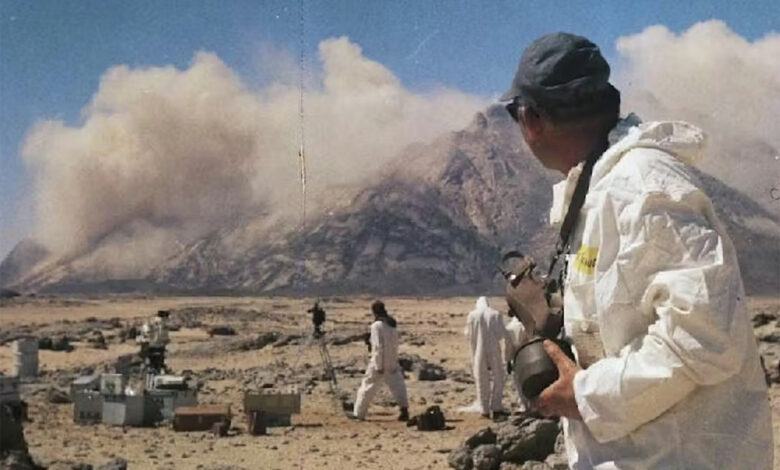
The operation began in the In Acre region in the state of Tamanrasset, specifically at the Taourirt Tan Afla site, where the famous nuclear explosion known as Brill occurred in 1962, according to reports from the Algerian News Agency and archival files published by the French newspaper Le Monde about nuclear tests in the Algerian desert.
In the same context, historical data confirm that the Brill experiment was one of the most dangerous underground explosions, after quantities of gases and radioactive materials leaked to the surface as a result of a technical failure to contain the explosion. Reports published in the French newspaper Le Figaro and archive files of the French Ministry of Defense indicate that the force of the explosion amounted to the equivalent of 150,000 tons of TNT, causing long-term contamination of soil and rocks, with the presence of radioactive elements such as cesium 137 and plutonium recorded.
On the other hand, specialized Algerian teams began the process of collecting contaminated waste and storing it inside designated cement containers according to precise security standards, in a step described as the first of its kind on this specific site. The operation relies on national expertise and local equipment, after decades of studies and follow-up, in the absence of accurate maps and complete archival information from the French side, which complicated the task of identifying the most dangerous points in the vicinity of the bombings.
In this context, this official move reopens a heavy issue that Algeria has long demanded to be settled in a transparent and fair manner. France began its first nuclear tests in Reggane on February 13, 1960, under the name Blue Jerboa, followed by other explosions bearing the names White, Red, and Green Jerboa, according to historical documents provided by the French Center for Military Archives. These bombings did not only target the land, but also caused human and environmental damage, the effects of which are still present in southern Algeria.
Specialists in international law also believe that these experiments constitute a historical crime against humanity and the environment, since they were conducted on colonized land and without regard to the safety of the local population. Testimonies of survivors reported by French and Algerian media confirm that many workers and residents were exposed to direct radiation without adequate protection.
In the end, the current clean-up process appears to be more than just a technical measure. It is a sovereign message confirming that Algeria is continuing to confront the toxic legacy of French colonialism, and a demand to reveal the full truth and compensate the victims, so that the southern desert does not remain a silent witness to one of the most serious crimes of the twentieth century.
@ Alaa my life
#Algeria #cleanses #desert #legacy #French #bombings
#oussama_boulegheb #elhiwardz #alakhibariat.xyz #elhiwar #elhiwar-en