The French Interior Minister admits: “The dialogue with Algeria is stronger than all escalation policies” – New Algeria

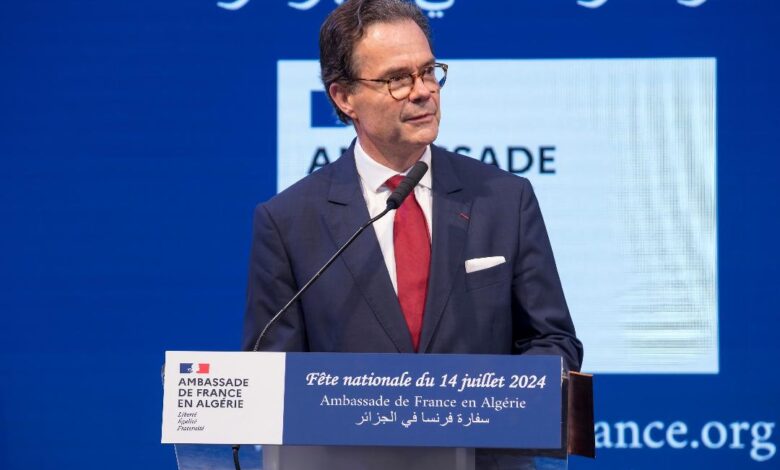
During his participation in the ambassadors’ breakfast organized by the Grand Mosque in Paris on Thursday evening, French Interior Minister Laurent Nunez praised the policy of dialogue that had been adopted with Algeria. In his speech, he addressed the status of Islam in France, wearing the hijab, as well as the policy of dialogue with Algeria, while he directed harsh criticism at the former French Interior Minister, Bruno Rotayo, who had always seized any opportunity to make “provocative” and “hostile” statements towards Algeria, in line with French right-wing agendas.
Unlike his predecessor, Bruno Rotayo, who boycotted the event in 2025, Laurent Nunez, during the traditional breakfast banquet reserved for ambassadors at the Grand Mosque of Paris, touched on the level and prospects of French-Algerian relations, and the significant increase in anti-Muslim actions during the year 2025, recalling the importance and role of the Grand Mosque in Paris, which is subject to continuous attacks by right-wing movements because of its relations with Algeria.
For the French Minister of the Interior, who expressed his “sincere happiness” at attending this iftar, the Grand Mosque in Paris remains, a century after its founding in 1926 in honor of the memory of Muslim soldiers who fell defending France during World War I, “as it has always been: a bridge between cultures, a bridge between generations, and a bridge between faith and the republic,” recalling Imam Abdelkader Mesli, who saved thousands of Jews during World War II. With issues related to religion, he said: “My approach is based on the utmost firmness in confronting religious fanaticism, without launching any speech or adopting any position that hurts, harshes, or stigmatizes others.” He also added that he “prefers the path of dialogue and words that calm.”
Nunez said: “I was able to measure the virtues of the dialogue approach again during my recent visit to Algeria. The power of dialogue is much stronger than all the policies of confrontation and tug of war,” which Bruno Rutayo had previously adopted, and which led bilateral relations to the level of estrangement. Nunez had visited Algeria on February 16 and 17, where he met with the President of the Republic, Abdelmadjid Tebboune, 18 months after an unprecedented crisis that struck relations between the two countries. This visit allowed the relaunch of cooperation between Algeria and Paris in the fields of security and migration after several months of complete cessation.
By highlighting the advantages of dialogue, Nunez confirms his satisfaction with the results he achieved during his visit to Algeria. He also directed an indirect criticism of his predecessor and the French right-wing movements that call for a tough confrontation with Algeria. On the occasion, Nunez announced his disagreement with former Interior Minister Bruno Rotayo, who has a right-wing leaning, over two basic issues: the nature of relations between France and Algeria, and the issue of minors wearing the hijab in public space.
Without expanding on the visit, Nunez moved to the situation of Muslims in France, noting that 326 anti-Muslim acts were recorded in France during 2025, which represents a significant increase of 90 percent. Among these attacks was the killing of the 22-year-old Malian youth, Abou Bakr Cisse, inside a mosque in the Gard region on April 25, 2025, as well as the killing of Tunisian Hicham Marawi on May 31 in the Var region.
In this regard, Nunez said: “These heinous crimes shook the entire French society,” adding that “their perpetrators are sworn enemies of the Republic.” He also reaffirmed his position on the proposal defended by right-wing movements to ban the wearing of the hijab on minors in France, saying that “I will not be the person who goes to explain to children that wearing the hijab poses a threat to republican coexistence. I will not do so because I do not believe in it, and because such a measure will only divert attention from the real threat.” He added: “It is an idea that weakens the real battle that must be fought against political Islam, which is an essential battle.”
Nunez concluded his speech by saying: “Saying that Islam is incompatible with the Republic is completely unacceptable. Those who claim that make themselves enemies of the secular Republic, that is, France, which guarantees everyone the freedom to believe and practice religious rituals. There is no other definition of secularism,” expressing his support for the Dean of the Grand Mosque in Paris, in light of the growing campaigns of escalation and hostility against the Arab and Islamic community in France.
Deep concern about the growth of anti-Muslim rhetoric.
The Dean of the Grand Mosque in Paris, Shams al-Din Hafid, informed French Interior Minister Laurent Nunez of the deep concern experienced by Muslims in France, in light of the growing hostile campaigns driven by the French right and its followers.
During the ambassadors’ breakfast organized by the Foundation, the Dean of the Grand Mosque in Paris issued a worrying warning about the situation of Muslims in France, in a context characterized by a significant rise in anti-Islamic actions, saying: “I cannot hide the deep anxiety that afflicts our Muslim citizens today. Unfortunately, we are witnessing an alarming rise in anti-Muslim actions and rhetoric. Threats, attacks, and stigmatizing statements are harmful and cause concern, and they create a harmful climate that weakens national cohesion.”
In the presence of French Interior Minister Laurent Nunez, Hafid recalled the “horrific assassination” of the young Malian man, Boubacar Cisse, on April 25, 2025, an incident that “deeply shocked our Muslim citizens.” He also referred to another incident that occurred one month later, on May 31, 2025, when Tunisian citizen Hicham Marawi was killed by his neighbor out of “racial hatred,” which “revived the feeling of insecurity once again.” “These actions were seen as an indication of an environment in which hatred can find fertile ground,” Hafeez added.
This comes at a time when France is witnessing a rise in the influence of the far right, accompanied by an increase in racist rhetoric and a significant increase in anti-Muslim actions, which rose by 88 percent during 2025, according to official figures. The Dean of the Grand Mosque in Paris pointed out that Muslims in France, despite being subjected to stigma, are constantly asked to prove their loyalty to their country. In this regard, he said: “Many of our Muslim citizens feel that they are always required to justify themselves, and that they are viewed through a lens of suspicion,” but in return he stressed that they are: “deeply attached to their country, France.”
Shams al-Din Hafid revealed the results of a survey conducted by his organization, saying, by the way, that “90 percent of the Muslims surveyed believe that it is entirely possible to integrate into French society while continuing to practice their religion,” stressing that “France’s Islam does not demand privileges or exceptional treatment, but rather simply demands the fairness, consideration, and respect that all citizens deserve.” Hafeez also touched on the difficulties faced by some imams of the Grand Mosque in Paris when renewing residence permits, highlighting that some of them were ordered to leave French territory (OQTF), even though the imams sent from Algeria to deliver sermons in France had never violated the law. In this context, the French Minister of the Interior called for the necessity of intervention in order to settle their situations and find a solution to this problem.
Abdo.H
#French #Interior #Minister #admits #dialogue #Algeria #stronger #escalation #policies #Algeria