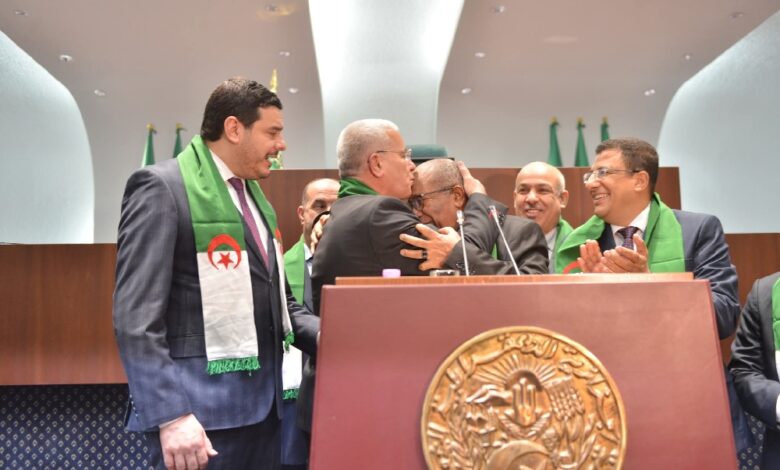
Professor Meziane Saidi confirmed that Parliament’s ratification of the draft law criminalizing colonialism in both chambers of Parliament is a historic day.
Professor Meziane, professor of modern and contemporary history at the Higher Normal School of Bouzareah, highlighted, in an intervention on national radio, that the issue of criminalizing colonialism has been going on for 63 years, saying: “We as historians have experienced it at the level of our writings, and it was the turn at the level of the parliamentary and second chambers to enter history through this law, when the political will was available represented by the highest executive authority, which is the President of the Republic, Abdelmadjid Tebboune.” He added that the project opened many doors and will work to awaken Historical awareness among African nations.
The professor stressed that the work now requires recruiting the efforts of historians, media figures, especially legal professionals, and pointed out that “talking about French colonialism is painful to an unimaginable degree, because historians know the nature of French crimes, which were recorded in the books of Algerian historians specializing in the contemporary history of Algeria, extending over 37 centuries.”
The academic explained that the nature of French colonialism will not be matched in the history of humanity, as it has become an example, and today the Zionist occupation draws from the colonial historical past of the French crimes committed in Algeria to apply them to our brothers in Palestine, indicating that the crimes of the French occupation are not limited to the crimes of extermination of the Algerian race only, and that the greatest crime is the attempt of French colonialism to eliminate the existence of a previously existing state, which is Algeria.
He highlighted that evidence of colonial crimes exists and is documented, namely the genocide of Algerians, political and administrative crimes, economic crimes, such that Algeria became the main financier of the motherland, “France,” and social crimes represented by the nicknames that the Algerians carried that insulted modesty, through the Civil Status Law of March 23, 1882.
The historian pointed out that in the sixties of the last century, Napoleon III considered the Algerians a French subject, to the extent that he went beyond the Indigo law, and the treatment of the Algerians was very lowly. He talked about cultural crimes and fighting the Arabic language, the language of the Qur’an, and from the religious aspect, an attempt to Christianize the Algerians, and these are facts documented through French archives and sources, the academic added.
The law allows for the prosecution of colonial France. Professor Meziane confirmed that the draft law criminalizing colonialism is an internal matter that concerns Algeria, but through this law we can resort to so-called international bodies to prosecute colonial France for its crimes, because the consequences of this colonialism continue to this day.
Historian Meziane believes that the law must be followed by other laws and the work must be collective in coordination with the African continent, especially in light of the current difficult international context. He said, “We do not expect France to confess to these crimes overnight, because it affects its reputation, especially since it has become involved in political forums and is floundering in an economic crisis.”
Professor Meziane believes that the step of criminalizing colonialism would be followed by other steps that would activate the work of restoring rights. We value the proposed law amending the Algerian nationality, and the researcher appreciated the initiative of Parliament’s approval of the proposed law amending the Algerian nationality, saying, “With this law, against everyone who speaks against the national state, his citizenship must be stripped from him.” Professor Meziane considered that the project to criminalize colonialism is an initial achievement and must have an impact on the field level, and be followed by other steps.
The historian explained that this law criminalizes the French state and not individuals, because there were political figures during the occupation who were acting in accordance with French laws, and that the colonial policy pursued in Algeria during the occupation involved politicians, military men and clerics, in the name of the French state. Therefore, they are state crimes, not crimes of individuals. He believes that efforts must be coordinated with West Africa, which was also subjected to French colonialism, saying: “If efforts are united, we will go to the international court, and it is our business to demand recognition, then apology, and then compensation.” The radio guest pointed out, “The size of the compensation is not money. The beginning is with the Kasbah treasury, which is estimated at thousands of billions in modern language, and the skulls of the martyrs of the resistance, which the French Parliament considers French heritage.”
The academic explained that the apology for France is an acknowledgment of the nature of the French state’s crime committed in Algeria, because it tried to eliminate the Algerian state from existence, which existed, and would diminish the value of this French state, which was calling for human rights and false principles. The researcher confirmed that France is a war criminal, and its dealings now with the peoples of the African continent are in accordance with the colonial bond because they did not digest Algeria’s independence and its exit from the French colonial circle, especially with the spread of political awareness on The level of African countries, and he added that France must acknowledge that Algeria is a sovereign state with its own men and political institutions, and its diplomatic relations based on principles and not the diplomacy of barter and interests.
Meziane Saidi highlighted that, Algeria contributed to the independence of many African peoples, during the revolution, and also after the restoration of national sovereignty by embracing the leaders of African liberation movements, whether in Zimbabwe, Botswana, or South Africa, and Mandela’s testimony, that “the Algerian revolution made him a man,” is the greatest evidence, and the historian confirmed, “Algeria became the Kaaba of liberation and the demand to criminalize French colonialism, because there are historical episodes in which Algeria plays a role.” A leadership role.
#law #criminalizing #colonialism #awaken #historical #awareness #African #nations
#oussama_boulegheb #elhiwardz #alakhibariat.xyz #elhiwar #elhiwar-en